
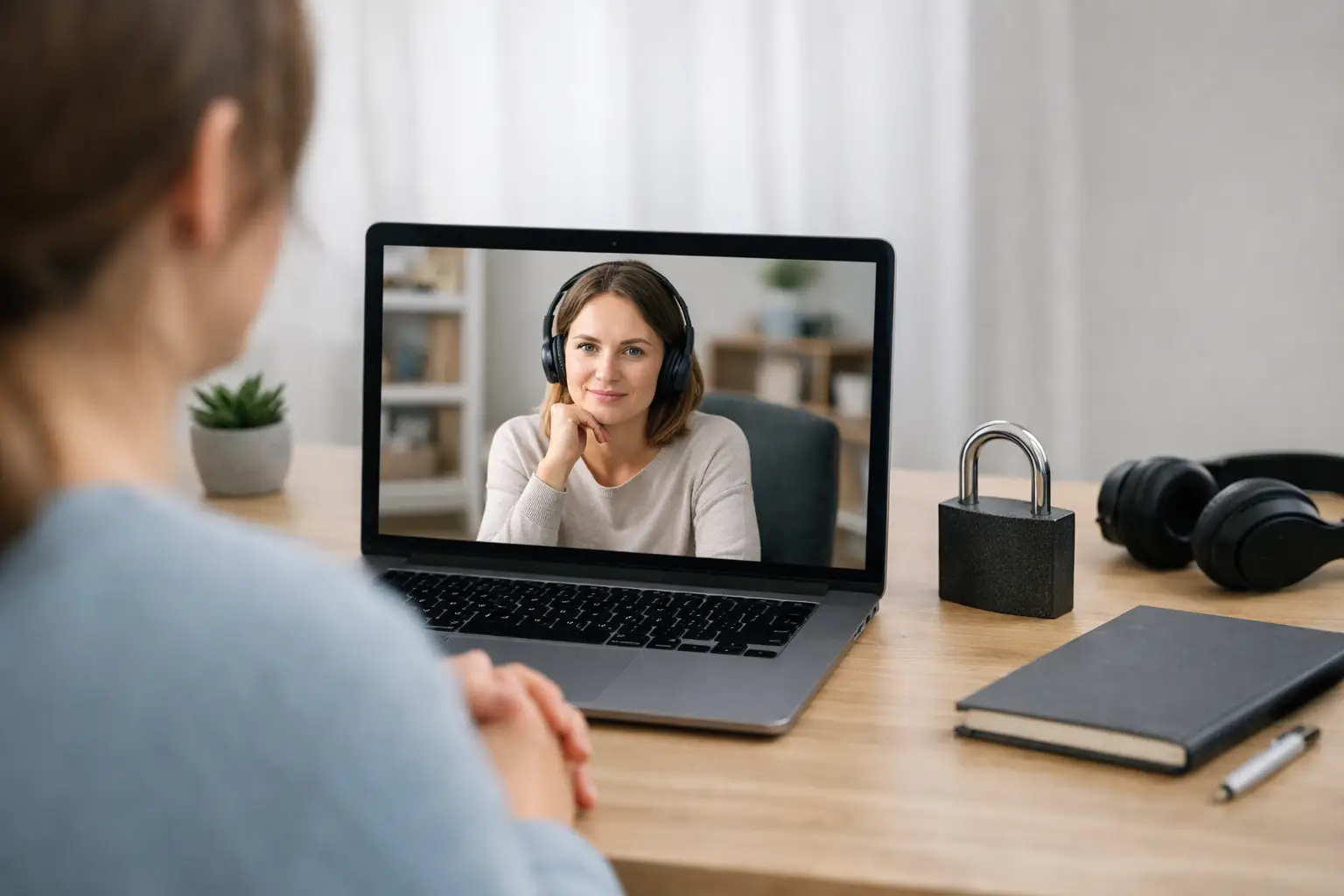
You may be ready to speak about a recurring dream, a difficult relationship change, grief that has not found words, or an experience that shifted how you see yourself. Before saying any of it aloud through a screen, a natural question arises: is online counselling confidential?
In most cases, yes. Online counselling is designed to offer the same professional privacy expectations as therapy held in an office. But confidentiality is not a vague promise or an absolute secret in every possible circumstance. It is a professional and legal commitment with clear boundaries, practical considerations, and a few limits that your therapist should explain before meaningful work begins.
Knowing how those boundaries work can help you choose care with greater confidence. Your experience is worth exploring, and you deserve to understand how it will be held.
What confidentiality means in online counselling
Confidentiality means that what you share with your therapist is private. A therapist does not casually discuss your sessions with family members, employers, friends, or other professionals. They generally cannot confirm that you are a client, share notes, or disclose the content of therapy without your written permission.
This applies whether you are discussing anxiety, trauma, dreams, relationship patterns, identity questions, or the meaning of an intense experience. It also applies to work that may feel especially personal or difficult to explain, including psychedelic preparation or integration. Therapy can be a place to meet yourself at a deeper level without needing to perform certainty, minimize your feelings, or make your inner life sound acceptable to someone else.
Professional confidentiality is supported by ethical standards, privacy laws, and the therapist’s licensing or registration requirements. A Registered Clinical Counsellor, for example, has professional responsibilities around informed consent, record keeping, privacy, and the protection of client information. The exact laws that apply can vary based on where you and your therapist are located, so a responsible provider will be clear about their jurisdiction and privacy practices.
Online therapy does add a technological layer. Instead of entering a private office, you connect through a video platform, phone line, or secure client portal. A careful practice uses tools intended for health care communication and has procedures for protecting records, scheduling details, and payment information. No technology can promise zero risk, but thoughtful systems significantly reduce unnecessary exposure.
The limits to confidentiality: when a therapist may need to act
Therapists protect privacy as fully as the law and ethics allow. There are, however, limited circumstances in which they may be required or permitted to share information without your consent. These situations are usually connected to immediate safety or the protection of a vulnerable person, not to judgment about what you have felt, thought, or experienced.
A therapist may need to take action if they believe there is an imminent and serious risk that you will harm yourself or someone else. They may also have reporting obligations when they learn about suspected abuse or neglect of a child, older adult, or other legally protected vulnerable person. A court order can sometimes require records or testimony, although therapists typically respond carefully and only disclose what is legally required.
These limits can feel concerning, especially if you are carrying thoughts or experiences you have not told anyone. It may help to remember that discussing painful feelings, trauma memories, intrusive thoughts, or past substance use does not automatically trigger a report. Therapy is often where those experiences can be explored safely. If a safety issue does arise, a trauma-aware therapist will usually try to speak with you openly about what is happening and what support is needed, whenever doing so is possible and safe.
Confidentiality also has practical exceptions related to professional care. A therapist may consult with a qualified clinical supervisor or peer consultant to support good treatment, while protecting your identity as much as possible. Administrative staff may have limited access to the information they need for scheduling or billing. You can ask who has access to your information and why.
Privacy is different from secrecy
It can be useful to distinguish confidentiality from secrecy. Confidentiality creates a protected therapeutic space. Secrecy can sometimes be a burden you have had to carry alone.
You remain in control of what you share and when. A good therapist will not pressure you to disclose more than feels manageable. At the same time, therapy can gently help you notice what silence has been protecting, what it may be costing you, and what this experience may be asking you to notice. That exploration happens at your pace.
How secure is online counselling in practice?
The privacy of an online session depends on both the therapist’s systems and your own environment. A secure platform matters, but the room you are sitting in matters too.
Your therapist should use a professional video service rather than a casual social video app, protect devices and records with passwords and appropriate security measures, and explain how electronic communications are handled. Email, for instance, can be useful for scheduling but is not always the best place for detailed therapeutic material. Some practices use secure portals for forms, documents, and messages because they offer greater protection.
At home, consider whether another person can overhear you through a wall, enter unexpectedly, or access your phone or computer. You do not need a perfectly silent home to benefit from therapy. Headphones, a closed door, a white-noise machine, a parked car in a safe private location, or a walk in a private outdoor space during a phone session may help. The goal is not perfection. It is creating enough privacy for you to speak honestly and stay present.
If you share a home with a partner, roommate, or family member, you may also want to decide in advance what you will say if someone asks about your appointment. You are not obligated to explain. A simple statement such as, “I have a private appointment,” may be enough.
Questions to ask before your first online session
You do not need to become a privacy expert before beginning therapy. Still, a few direct questions can help you understand whether a practice feels careful and trustworthy. You might ask how sessions are conducted securely, where records are stored, whether sessions are recorded, how email and text messages are used, and who can access your file.
It is also reasonable to ask about the therapist’s location, credentials, and the legal limits of confidentiality that apply to your care. If you are seeking support around an expanded-state experience, dreams, trauma, or material that feels emotionally charged, ask how the therapist approaches pacing and safety. The answer should be clear, respectful, and free of pressure.
At Gaia Counselling, informed consent is part of creating a steady therapeutic container. Before deeper work begins, you should have space to understand practical policies, ask questions, and decide whether the therapeutic fit feels right. A discovery call can be a low-pressure place to ask about the process, though it is wise to save detailed personal history for a formal clinical session once care and privacy procedures are established.
Your consent matters throughout therapy
Confidentiality is not a one-time form you sign and never revisit. It is part of an ongoing relationship built through clarity and consent. If you want your therapist to coordinate with a physician, partner, family member, or another provider, you can discuss what should be shared and sign a specific authorization. You can also limit that permission or withdraw it, subject to legal and clinical requirements.
You can ask for clarification at any point. Perhaps your life circumstances change and you need to take sessions from a less private setting. Perhaps you are unsure whether something you say could require a safety response. Perhaps you want to understand your access to records. These are appropriate therapy questions, not inconveniences.
A therapist who welcomes them is demonstrating something meaningful: your autonomy is part of the work. Online counselling can offer real privacy, depth, and continuity of care, provided that professional safeguards and honest conversations are in place. If you are holding something difficult, confusing, or unfinished, you do not have to carry it alone. You can begin by asking the questions that help you feel safe enough to be heard.